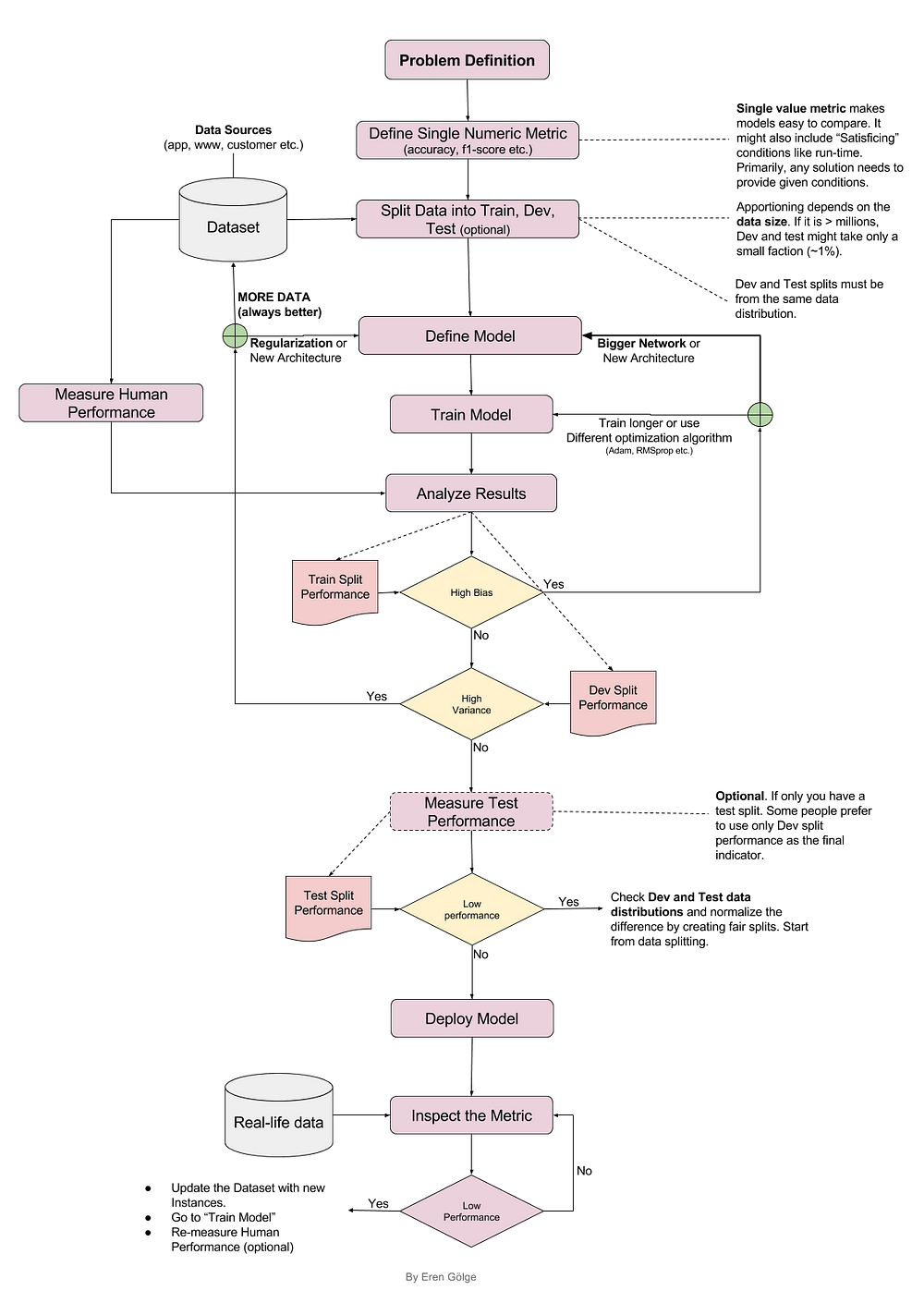
Designing a Deep Learning Project
The Present and Future of Quantum Computing for AI
Quantum computing is still in it’s infancy, and no universal architecture for quantum computers exists right now. However, their prototypes are already here and showing promising results in cryptography, logistics, modelling and optimization tasks. For AI researchers optimization and sampling is particularly important, because it allows to train Machine Learning models much faster with higher accuracy.
Artificial intelligence could be the future of banking
By leveraging AI, banks can engage with consumers in a faster and more consistent manner. They can use “bots” at contact centres for basic inquiries to free up employees for more complicated questions. They can use robo-advisers to provide basic investment services at lower cost.
New app scans your face and tells companies whether you’re worth hiring
HireVue, a company with a “video interview intelligence platform,” wants to make that easier by using artificial intelligence to do the heavy lifting for you and screen multiple candidates at once.
Pandas tips and tricks
This post includes some useful tips for how to use Pandas for efficiently preprocessing and feature engineering from large datasets.
The Hard Thing About Machine Learning
Building systems is hard; building machine learning systems that give robust predictions is especially hard.
Aug. 2017 Hive User Group Meeting @HortonWorks
1. Hive on Spark, production experience @Uber (Xuefu Zhang)
2. Reair and its usage for Uber's multi data center replication (Zheng Shao)
3. ACID, use cases in data management (Carter Shanklin)
4. Optimized Hive replication (Anishek Agarwal)
5. LLAP: Locality is dead (in the cloud) (Gopal Vijayaraghavan)
6. Don't reengineer, reimagine: Hive buzzing with Druid's magic potion (Slim Bouguerra)
Friday, August 25, 2017
Friday, August 18, 2017
Recent AI, Big Data, Deep Learning, Machine Learning Info Digest 2017/08/18
Thoughts after taking the Deeplearning.ai courses
The fast AI course mainly teaches you the art of driving while Andrew’s course primarily teaches you the engineering behind the car.
DeepMind and Blizzard open StarCraft II as an AI research environment
DeepMind's scientific mission is to push the boundaries of AI by developing systems that can learn to solve complex problems. To do this, we design agents and test their ability in a wide range of environments from the purpose-built DeepMind Lab to established games, such as Atari and Go.
Hype or Not? Some Perspective on OpenAI’s DotA 2 Bot
As I started looking more into what exactly the DotA 2 bot was doing, how it was trained, and what game environment it was in, I came to the conclusion that it’s an impressive achievement, but not the AI breakthrough the press would like you to believe it is. That’s what this post is about.
Artificial Intelligence Is Likely to Make a Career in Finance, Medicine or Law a Lot Less Lucrative
First generation robots worked in factories. Second generation robots are preparing for white-collar professions. Sort of like people.
How to create a Neural Network in JavaScript in only 30 lines of code
In this article Per Harald Borgen will show you how to create and train a neural network using Synaptic.js, which allows you to do deep learning in Node.js and the browser.
Finding chairs the data scientist way! (Hint: using Deep Learning) – Part I
In this article, Faizan Shaikh will cover how I defined the problem. I will also mention what were the steps I took to solve the problem. Consider it as a raw uncut version of my experience as I tried to solve the problem.
Labels:
AI,
Andrew Ng,
Deep Learning,
DeepMind,
Fast.AI,
Javascript,
Neural Network,
OpenAI,
StarCraft
Friday, August 11, 2017
Recent AI, Big Data, Deep Learning, Machine Learning Info Digest 2017/08/11
ICML 2017 tutorial
34th International Conference on Machine Learning
Deep Reinforcement Learning, Decision Making, and Control
In this tutorial, we will cover the foundational theory of reinforcement and optimal control as it relates to deep reinforcement learning, discuss a number of recent results on extending deep learning into decision making and control, including model-based algorithms, imitation learning, and inverse reinforcement learning, and explore the frontiers and limitations of current deep reinforcement learning algorithms.
Deep Learning for Health Care Applications: Challenges and Solutions
In this tutorial, we will discuss a series of problems in health care that can benefit from deep learning models, the challenges as well as recent advances in addressing those. We will also include data sets and demos of working systems.
Sequence-To-Sequence Modeling with Neural Networks
Sequence-To-Sequence (Seq2Seq) learning was introduced in 2014, and has since been extensively studied and extended to a large variety of domains. Seq2Seq yields state-of-the-art performance on several applications such as machine translation, image captioning, speech generation, or summarization. In this tutorial, we will survey the basics of this framework, its applications, main algorithmic techniques and future research directions.
Interpretable Machine Learning
In this talk, we first suggest a definitions of interpretability and describe when interpretability is needed (and when it is not). Then we will review related work, all the way back from classical AI systems to recent efforts for interpretability in deep learning. Finally, we will talk about a taxonomy for rigorous evaluation, and recommendations for researchers. We will end with discussing open questions and concrete problems for new researchers.
Deep Learning with Andrew Ng
In five courses, you will learn the foundations of Deep Learning, understand how to build neural networks, and learn how to lead successful machine learning projects. You will learn about Convolutional networks, RNNs, LSTM, Adam, Dropout, BatchNorm, Xavier/He initialization, and more. You will work on case studies from healthcare, autonomous driving, sign language reading, music generation, and natural language processing. You will master not only the theory, but also see how it is applied in industry. You will practice all these ideas in Python and in TensorFlow, which we will teach.
Heroes of Deep Learning: Andrew Ng interviews
Geoffrey Hinton
Yoshua Bengio
Pieter Abbeel
Ruslan Salakhutdinov
Ian Goodfellow
Andrej Karpathy
34th International Conference on Machine Learning
Deep Reinforcement Learning, Decision Making, and Control
In this tutorial, we will cover the foundational theory of reinforcement and optimal control as it relates to deep reinforcement learning, discuss a number of recent results on extending deep learning into decision making and control, including model-based algorithms, imitation learning, and inverse reinforcement learning, and explore the frontiers and limitations of current deep reinforcement learning algorithms.
Deep Learning for Health Care Applications: Challenges and Solutions
In this tutorial, we will discuss a series of problems in health care that can benefit from deep learning models, the challenges as well as recent advances in addressing those. We will also include data sets and demos of working systems.
Sequence-To-Sequence Modeling with Neural Networks
Sequence-To-Sequence (Seq2Seq) learning was introduced in 2014, and has since been extensively studied and extended to a large variety of domains. Seq2Seq yields state-of-the-art performance on several applications such as machine translation, image captioning, speech generation, or summarization. In this tutorial, we will survey the basics of this framework, its applications, main algorithmic techniques and future research directions.
Interpretable Machine Learning
In this talk, we first suggest a definitions of interpretability and describe when interpretability is needed (and when it is not). Then we will review related work, all the way back from classical AI systems to recent efforts for interpretability in deep learning. Finally, we will talk about a taxonomy for rigorous evaluation, and recommendations for researchers. We will end with discussing open questions and concrete problems for new researchers.
Deep Learning with Andrew Ng
In five courses, you will learn the foundations of Deep Learning, understand how to build neural networks, and learn how to lead successful machine learning projects. You will learn about Convolutional networks, RNNs, LSTM, Adam, Dropout, BatchNorm, Xavier/He initialization, and more. You will work on case studies from healthcare, autonomous driving, sign language reading, music generation, and natural language processing. You will master not only the theory, but also see how it is applied in industry. You will practice all these ideas in Python and in TensorFlow, which we will teach.
Heroes of Deep Learning: Andrew Ng interviews
Geoffrey Hinton
Yoshua Bengio
Pieter Abbeel
Ruslan Salakhutdinov
Ian Goodfellow
Andrej Karpathy
Labels:
Andrew Ng,
Been Kim,
Deep Learning,
Deep Reinforcement Learning,
DeepMind,
Finale Doshi-Velez,
Google,
Harvard,
ICML,
Jimeng Sun,
Machine Learning,
Navdeep Jaitly,
Oriol Vinyals,
Seq2Seq,
Sergey Levine,
Yan Liu
Friday, August 4, 2017
Recent AI, Big Data, Deep Learning, Machine Learning Info Digest 2017/08/04
The future of deep learning
This post is adapted from Section 3 of Chapter 9 of Francois Chollet's book, Deep Learning with Python (Manning Publications). It is part of a series of two posts on the current limitations of deep learning, and its future. You can read the first part here: The Limitations of Deep Learning.
What's Next For Deep Learning?
Answer by Ian Goodfellow, AI Research Scientist at Google Brain, on Quora: There are a lot of things that are next for deep learning. Instead of thinking of moving forward in one direction, think of expanding outward in many directions.
TensorFlow Estimators: Managing Simplicity vs. Flexibility in High-Level Machine Learning Frameworks
The authors present a framework for specifying, training, evaluating, and deploying machine learning models. Our focus is on simplifying cutting edge machine learning for practitioners in order to bring such technologies into production.
Nvidia uses AI to create 3D graphics better than human artists can
Nvidia’s researchers have created a way for AI to create realistic human facial animations in a fraction of the time it takes human artists to do the same thing.
Cutting Edge Deep Learning for Coders—Launching Deep Learning Part 2
These 15 hours of lessons take you from part 1’s best practices, all the way to cutting edge research.
Labels:
3D,
AI,
Deep Learning,
Fast.AI,
Francois Chollet,
Google,
Ian Goodfellow,
Jeremy Howard,
Machine Learning,
Nvidia,
Quora,
TensorFlow
Wednesday, July 26, 2017
Recent AI, Big Data and Machine Learning Info Digest 2017/07/26
Deep Reinforcement Learning: An Overview (by Yuxi Li, version 3, July 15, 2017)
We give an overview of recent exciting achievements of deep reinforcement learning (RL). We discuss six core elements, six important mechanisms, and twelve applications. We start with background of machine learning, deep learning and reinforcement learning. Next we discuss core RL elements, including value function, in particular, Deep Q-Network (DQN), policy, reward, model, planning, and exploration. After that, we discuss important mechanisms for RL, including attention and memory, in particular, differentiable neural computer (DNC), unsupervised learning, transfer learning, semi-supervised learning, hierarchical RL, and learning to learn. Then we discuss various applications of RL, including games, in particular, AlphaGo, robotics, natural language processing, including dialogue systems (a.k.a. chatbots), machine translation, and text generation, computer vision, neural architecture design, business management, finance, healthcare, Industry 4.0, smart grid, intelligent transportation systems, and computer systems. We mention topics not reviewed yet. After listing a collection of RL resources, we present a brief summary, and close with discussions.
ImageNet Object Localization Challenge
This year, Kaggle is thrilled to be the official host of all three ImageNet Challenges for the first time including the other two competitions:
Object Detection Challenge
Object Detection from Video Challenge
Deep Learning for NLP Best Practices
This post is a collection of best practices for using neural networks in Natural Language Processing. It will be updated periodically as new insights become available and in order to keep track of our evolving understanding of Deep Learning for NLP.
In this tutorial, we will use an Apache Zeppelin notebook for our development environment to keep things simple and elegant.
This is Part 1 of 3 in a series of posts that looks at the landscape of the artificial intelligence industry and the companies and institutes developing products that are moving the needle of knowledge of machine intelligence and consciousness forward for humanity.
This list contains companies working on artificial intelligence and machine learning products primarily for business use, non-specific to any industry. Industry specific AI will be the final part of this series.
Labels:
AI,
Deep Learning,
Hortonworks,
Imagenet,
Kaggle,
Liam Hänel,
NLP,
Reinforcement Learning,
Sebastian Ruder,
Spark,
Yuxi Li
Sunday, July 16, 2017
Recent AI, Big Data and Machine Learning Info Digest 2017/07/16
New Frontiers for Deep Learning in Robotics
In this workshop a wide range of renowned experts will discuss deep learning techniques at the frontier of research that are not yet widely adopted, discussed, or well-known in our community.
How AI And Deep Learning Are Now Used To Diagnose Cancer
Without a doubt one of the most exciting potential uses for AI (Artificial Intelligence) and in particular deep learning is in healthcare.
Lecture note <Brief Introduction to Machine Learning without Deep Learning>
By KyungHyun Cho All the things you need to know in order to become a certified ML scientist can be found there.
Data Preparation for Data Science: A Field Guide
Casey Stella presents a utility written with Apache Spark to automate data preparation, discovering missing values, values with skewed distributions and discovering likely errors within data.
Winning Strategies for Applied AI Companies
The aim of this post is to disclose a framework we have built when we look at Applied AI companies.
Labels:
AI,
Cancer,
Data Science,
Deep Learning,
Healthcare,
Robotics,
Spark
Tuesday, July 4, 2017
Recent AI, Big Data and Machine Learning Info Digest 2017/07/04
How to build a data science pipeline
Start with y. Concentrate on formalizing the predictive problem, building the workflow, and turning it into production rather than optimizing your predictive model. Once the former is done, the latter is easy.
How Deep Learning Is Personalizing the Internet
Personalization is no doubt one of the strongest imperatives today in the internet industry as a whole and deep learning almost certainly holds tremendous potential in this area. Therefore, businesses that aim to remain on the cutting edge need to keep an eye out for advancements in the field.
3 Massive Big Data Problems Everyone Should Know About
There are 3 Big Data concerns that should keep people up at night: Data Privacy, Data Security and Data Discrimination.
Deep Learning Research Review Week 2: Reinforcement Learning
This is the 2nd installment of a new series called Deep Learning Research Review by Adit Deshpande . This week he focuses on Reinforcement Learning.
Hands on with Deep Learning – Solution for Age Detection Practice Problem
In this article, Faizan Shaikh explained a simple benchmark solution for Age Detection Practice Problem.
Architecture of Convolutional Neural Networks (CNNs) demystified
Dishashree Gupta provides an intuition into convolutional neural networks by not going into the complex mathematics of CNN.
Subscribe to:
Posts (Atom)


